Article 2 of 5 | Following our May 2026 Chartwell webinar
The fork in the road
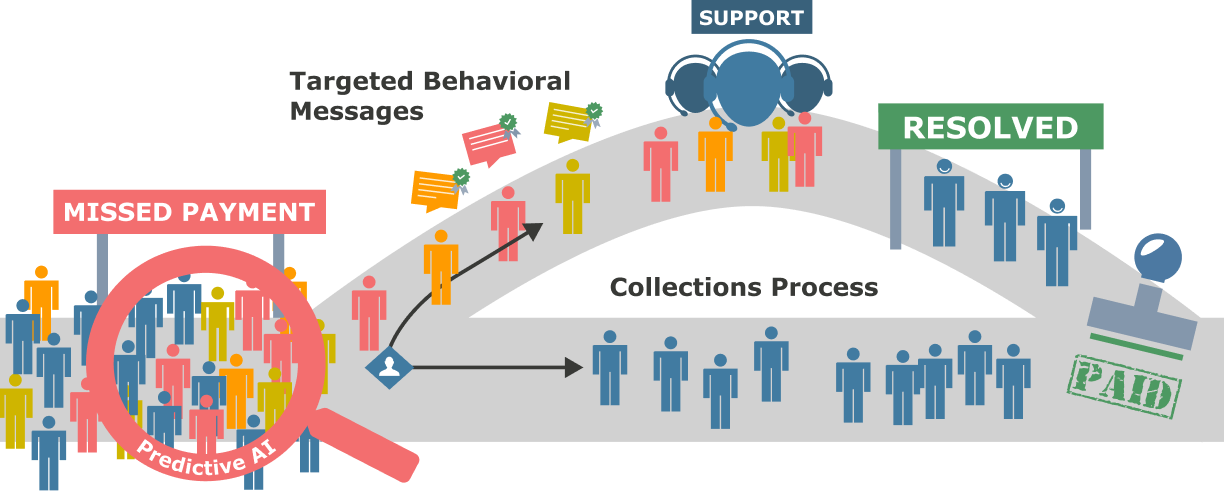
Every missed payment is a fork in the road. Most utilities are only looking at one path.
For some customers, the existing collections process is perfectly suited to the situation. A reminder is sent. The customer catches up. The matter is resolved through the normal process.
But for others, the missed payment on that invoice is the beginning of a different path. Short-term pressure starts to become persistent arrears. One unpaid bill rolls into the next. The customer becomes harder to reach. The debt grows, options narrow, and the eventual conversation becomes more difficult and costly for everyone.
The challenge for utilities is that, at the moment that invoice becomes overdue, those two groups can look very similar.
In the usual course of action, the system has been built to detect the event. The unpaid bill triggers a message. If the account remains unpaid, activity escalates. That logic is sensible, consistent, fair and compliant, and utilities need it.
But event-based processes have limitations. They are very good at recognising what has already happened. They are less able to distinguish what is likely to happen next.
They don’t see the trajectory. This distinction matters.
While these dynamics have always existed, increasing numbers of customers are now finding themselves under this sort of pressure. In research shared by the Smart Energy Consumer Collaborative, nearly one-third of customers reported struggling to pay their electricity bill, with the share even higher for lower-income households. Late payments have also increased. Yet fewer customers are applying for assistance programs.
That disconnect is important.
Customers are falling behind, and many are not finding their way to the support that already exists. Some may not know programs are available or assume they will not qualify. But for others, the barrier runs deeper than information. Financial stress activates a shame response that makes reaching out feel like an admission of failure. And the brain, under that level of threat, tends towards avoidance rather than action. The result is disengagement that can look, for the outside, like indifference. A companion piece exploring the psychology of debt is coming up in Article 3 in the series.

This is where early differentiation of customer types becomes so important.
The challenge is that financial stress rarely arrives with one obvious signal that a person in a collections team could simply spot and act on. If it did, you would expect utilities would already be doing it.
It is about using predictive AI to identify patterns that humans cannot realistically see at scale.
The shift
Rather than waiting until customers become visible through larger balances or repeated non-payment, utilities can begin to understand which customers are more likely to need a different kind of engagement earlier in their journey.
Making collections smarter
The missed payment remains the trigger. The collections process remains in place. But at that point, utilities can add a more targeted service message for customers who are predicted to be at higher risk of moving into deeper arrears.
What the message says matters
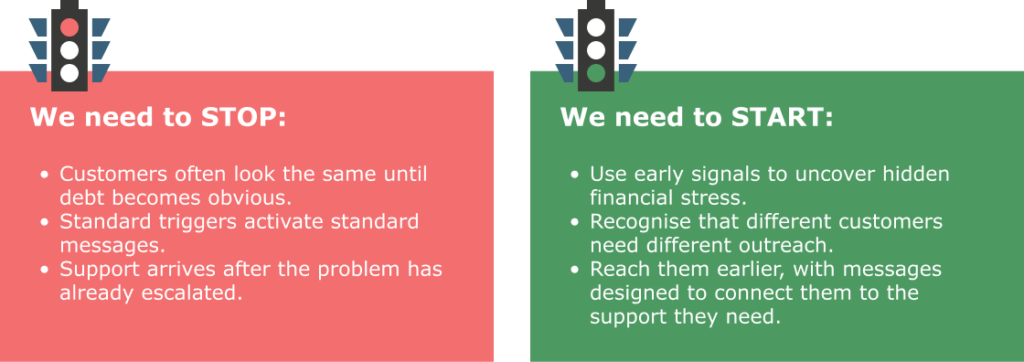
A standard reminder may be enough for a customer whose missed payment is a timing issue or oversight. But for someone beginning to experience financial stress, the wrong message can be ignored or avoided. Not because they do not care but because they feel overwhelmed or, embarrassed and the situation already feels too hard to engage with.
A better message does something different. It is designed to connect. It recognises the moment the customer is in. It reduces friction. It helps customers understand that support exists, and that acting early can make a difference.
The opportunity at the missed payment
Not to treat every customer as if they are in hardship. Not to over-service customers who will self-correct. And not to wait until arrears become so large that the only available levers are expensive, stressful and often less effective.
The opportunity is to identify the customers most likely to need help and reach them with the right kind of service message before the debt escalates. That is where outcomes can shift. For the customer, it may mean resolving a difficult situation earlier, with less stress and more confidence. For the utility, it may mean fewer accounts moving into late-stage arrears, lower collections effort, reduced disconnection risk and better use of existing support resources.
A missed payment is not just an administrative event. It is a fork in the road. Handled one way, many customers will recover through the normal process. Handled another way, the customers most at risk can quietly drift toward larger debt and more difficult outcomes. The difference is not simply whether a message is sent. It is whether the utility knows who is most likely to need a different conversation.
A missed payment is not just an administrative event.
It is a fork in the road.
SmartMeasures helps energy retailers and utilities reduce customer debt and improve retention through predictive AI and behavioural science. To continue the conversation from the webinar, contact us at [email protected] or use our contact page.
See the Smart Energy Info Graphic
Rebecca Wilson MSc (Business Psychology) is a Business Psychologist and Behavioural Science specialist at SmartMeasures.